Hydrolyzed rice protein reinforces existing hair from the inside by binding to damaged sites in the cortex; raw rice water mostly coats the surface instead. That single difference in molecule size determines whether a “rice protein” product actually strengthens hair or just smooths it temporarily. Below is a full breakdown of the mechanism, the limits, and how the major hydrolyzed rice protein products on the market compare.
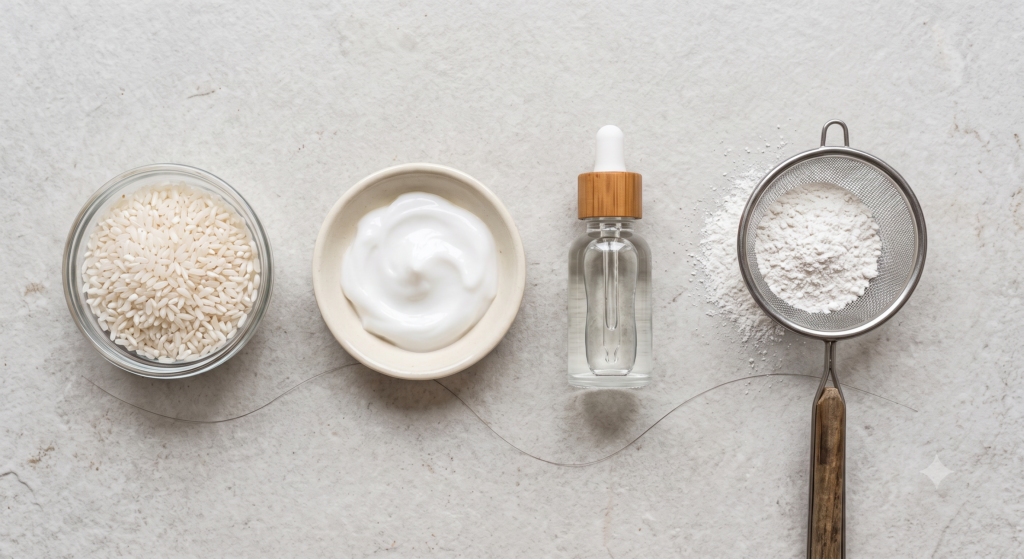
Hydrolyzed vs. Raw: The Distinction That Decides Everything
Hair is built almost entirely from keratin, and daily wear from heat, color, and friction breaks that structure down over time. Rice protein in its natural state is a large molecule, too big to pass through the hair’s cuticle. Applied as-is, or as rice water, it sits on the surface, offering some shine and slip but no interior reinforcement.
Hydrolysis breaks that large protein chain into short peptide fragments, typically under 1,000 Daltons, small enough to cross the cuticle and reach the cortex underneath. Manufacturers control this molecule size deliberately, since the entire functional benefit of a hydrolyzed protein product depends on the peptides being small enough to reach where damage actually lives, inside the shaft rather than on top of it.
The Mechanism: Adsorption, Not Absorption
The process is adsorption rather than the looser “absorption” language commonly used. Bleaching, coloring, heat styling, and mechanical stress from brushing create micro-gaps in the cortex and break down some of the hair’s natural disulfide bonds. Positively charged rice peptides bind to the negatively charged sites exposed by that damage, filling gaps and reinforcing the fiber where it has thinned.
Three measurable effects follow from that binding. Tensile strength improves, meaning the strand can stretch further before it snaps. Breakage under combing and brushing drops, since reinforced strands resist the friction that previously sheared them apart. Elasticity improves, since well-supported hair stretches and springs back while depleted hair snaps with little give. These are the same properties referenced when a product cites a tensile strength test or a breakage-reduction percentage, so it’s worth checking whether a claim traces back to one of these three measurable effects rather than a vaguer marketing phrase.
For more on how rice water performs when it’s used specifically for growth and repair, see Rice Water for Hair Growth and Repair: Who Should Use It and Who Should Be Careful.
What Rice Protein Cannot Do
Rice protein is not a substitute for moisture, and overusing it creates its own problem. Protein overload shows up as hair that feels stiff, straw-like, and prone to snapping rather than stretching, the opposite of the intended benefit. This risk is lower with properly hydrolyzed formulas that absorb into the strand than with raw rice water or protein-heavy products that build up on the surface, but it’s not zero.
Rice protein also cannot repair split ends once they’ve separated, and it does not change the hair growing out of the follicle. It reinforces the strand that already exists and slows further damage; it does not reverse structural damage that has already occurred. The practical implication is that rice protein needs to be balanced with hydrating ingredients and used on a schedule rather than daily, particularly in a leave-in or rinse-out mask with a meaningful protein concentration.
A useful way to think about the ceiling: protein and moisture function as two separate variables in a hair care routine, not one combined setting. Overloading on protein without matching moisture produces the stiff, brittle result described above. Overloading on moisture without enough protein tends to leave hair limp and overly stretchy, sometimes called moisture overload, which carries its own breakage risk. Neither extreme is the goal; the aim is keeping both roughly balanced for the specific hair type in question, which typically takes some observation and adjustment rather than following one fixed schedule regardless of results.
Comparing the Major Hydrolyzed Rice Protein Products
Three products illustrate the range of approaches on the market: Kitsch’s rice protein shampoo and conditioner, Mielle Organics’ rice water line, and Remilia Hair’s two-product system.
| Feature | Kitsch Rice Protein Duo | Mielle Organics Rice Line | Remilia Hair (Green Coco + Rice & Shine) |
|---|---|---|---|
| Rice protein form | Hydrolyzed rice protein | Primarily rice water (largely un-hydrolyzed) | Hydrolyzed rice protein, at 1% in the mask |
| Format | Daily shampoo and conditioner | Rinse and leave-in rice water products | Rinse-out mask (1-2x/week) + daily leave-in |
| Delivery mechanism | Surface-to-interior, lighter daily dose | Primarily surface coating and shine | Concentrated interior reinforcement (mask) + light daily reinforcement (leave-in) |
| Best suited for | Regular maintenance, lighter damage | Shine, slip, and surface smoothing | Split-intensity routine: deep repair plus daily protection |
Read-out: The clearest divide is between products built on hydrolyzed rice protein, which can reinforce the strand from inside, and products built on rice water, which primarily work at the surface. Within the hydrolyzed category, the remaining differences come down to concentration and frequency: a daily lighter dose versus a more concentrated periodic treatment paired with a lighter daily step.
How a Two-Product Rice Protein Routine Works
Remilia Hair’s Green Coco Hair Mask is a rinse-out treatment formulated with 1 percent hydrolyzed rice protein, alongside coconut oil, avocado oil, and an amino acid complex, meant for periodic deep repair. Cited testing shows up to 50 percent stronger hair after a single treatment, with a separate study on the hydrolyzed rice protein ingredient itself showing a 44.1 percent improvement in hair volume after five washes.
The Rice & Shine Leave-In Conditioner takes the opposite approach: a lightweight, no-rinse spray built around hydrolyzed rice protein, quinoa, and barley, designed for daily use. It’s positioned around heat protection up to 450°F / 232°C and color retention, with up to three times better color retention cited after repeated washes. Because it stays on the hair rather than rinsing out, it provides ongoing reinforcement and reduced friction through the day without the heavier protein load of a mask.
Do you know Rice Water for Hair Growth and Repair: The Science, the Risks, and What to Use? It covers the same growth-and-repair territory in video form, including some of the risk factors worth watching for.
Bottom Line
Hydrolyzed rice protein is the form that matters if the goal is structural reinforcement rather than surface shine, look for that exact term on the ingredient list, not just “rice water” or “rice extract.” Pair it with a moisturizing step so the strand stays flexible, and treat protein application as a scheduled routine rather than a daily habit. Whether the product in question is a daily-use duo, a rice water line, or a split-intensity mask-and-leave-in system, the same two questions determine whether it will actually work: is the protein hydrolyzed, and does the concentration match how often it’s meant to be used.
FAQs
Q: Is rice protein the same thing as rice water?
A: No. Rice water contains large, un-hydrolyzed proteins that mostly sit on the hair’s surface. Hydrolyzed rice protein is broken into much smaller peptides that can pass through the cuticle and bond inside the strand, which is where structural reinforcement actually happens.
Q: Will rice protein make my hair feel stiff?
A: It can, if overused. That effect, protein overload, is more common with raw rice water or surface-heavy formulas. Properly hydrolyzed formulas are designed to absorb rather than coat, which lowers that risk, but concentrated treatments are still generally meant for 1 to 2 uses a week rather than daily.
Q: How does Remilia Hair’s rice protein system compare to Kitsch and Mielle Organics?
A: Remilia splits delivery by intensity across two products: the Green Coco Hair Mask at 1 percent hydrolyzed rice protein for concentrated, periodic repair, and the Rice & Shine Leave-In for daily, lighter reinforcement. That’s closer to Kitsch’s hydrolyzed-protein approach than to Mielle’s rice-water-based line, but split across two formulas by intended frequency.
Q: Does rice protein actually make hair thicker, or does it just look that way?
A: Both, in different senses. Structurally, it reinforces existing strands so they resist breakage, which helps preserve density over time. Visually, it also helps each strand hold more moisture and swell slightly, plus smooths the cuticle so light reflects more evenly, which reads as added volume. It does not create new hair growth.
Q: How often should a rice protein hair mask be used?
A: For a rinse-out mask, 1 to 2 times per week is the general guideline, adjusted for how damaged or dry the hair is. Fine or lightly processed hair may only need it weekly, while heat- or color-damaged hair can use the upper end of that range.