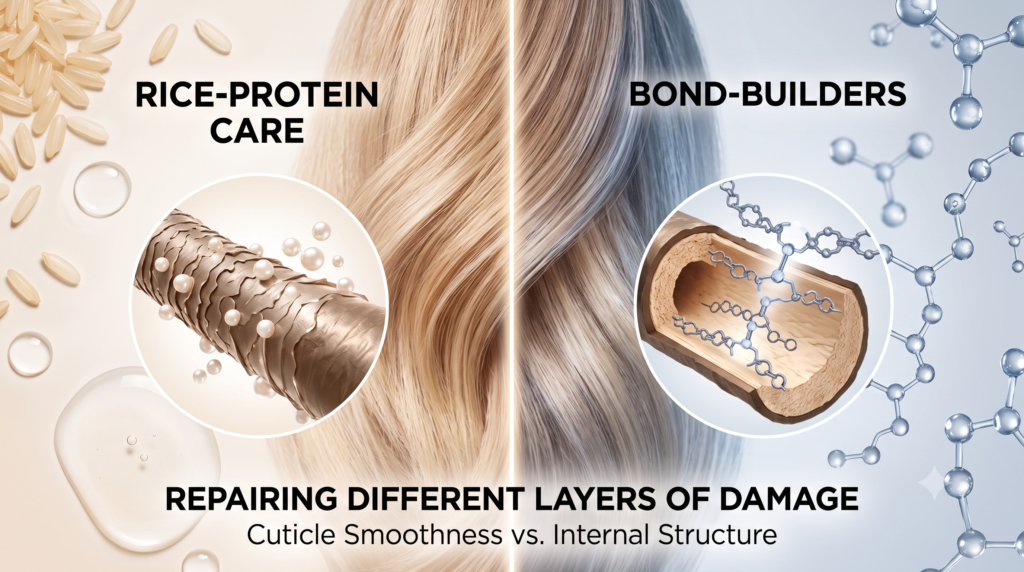
Short answer up front: rice-protein treatments and bond-builders are not competing products, they repair different parts of the hair, and most color-treated, chemically damaged hair benefits from both at different times. This guide breaks down what each category actually does, how to tell which one your hair needs right now, and how the two leading bond-repair names, Olaplex and K18, stack up against a rice-protein routine when compared side by side.
Why repair doesn’t mean one thing
Damage from bleach, color services, and heat styling happens in more than one place on the hair strand, and the products marketed to fix it are almost never built to address all of it at once. Some damage is surface-level: a rough, lifted cuticle that scatters light instead of reflecting it, which reads as dullness, frizz, or tangling. Some damage is structural: broken bonds inside the cortex, the hair’s inner layer, most commonly caused by bleach and other chemical processing.
Every product in this category is built to address one of these two layers, not both. Knowing which layer a product targets, before you buy it, is the single most useful thing you can learn before shopping for damaged, color-treated hair.
What rice-protein treatments are formulated to do
Rice-protein products use hydrolyzed rice protein, rice protein broken down into smaller peptides so it can sit on and around the hair shaft rather than rinsing straight out. It works at the cuticle and mid-shaft level: smoothing raised cuticle scales, filling in microscopic gaps left by porosity damage, and helping hair reflect light more evenly, which is the mechanism behind the shine most of these products advertise.
This is a genuinely useful, evidence-backed mechanism for daily and weekly maintenance. It is not, however, a chemical bond repair, and it isn’t formulated to reach the cortex. If your hair’s damage is mostly textural, dry, dull, tangling easily, or losing color vibrancy between salon visits, this is the more relevant category for your routine.
What bond-builders are formulated to do
Bond-builders solve a narrower and more specific problem: reversing broken bonds inside the cortex caused by bleach, lighteners, and other chemical services. Olaplex is built around patented bond-building chemistry designed to form new chemical bridges and relink what bleach breaks apart. K18 uses a different mechanism, a peptide formulation designed to reconnect broken keratin chains within the strand rather than targeting disulfide bonds directly.
Both operate at a structural level a topical rice-protein product isn’t designed to reach. That’s also why stylists typically use bond-builders as a pre-service or post-lightening step rather than recommending them as an everyday product.
Head-to-head: rice-protein routine vs. Olaplex vs. K18
The table below compares a rice-protein routine, using Remilia Hair’s Green Coco Hair Mask and Rice & Shine Leave-In Conditioner as the reference products, against Olaplex and K18 across the dimensions that actually matter when you’re deciding what to buy.
| Dimension | Rice-Protein Routine (Remilia Hair) | Olaplex | K18 |
|---|---|---|---|
| Primary mechanism | Hydrolyzed rice protein and quinoa smooth the cuticle and support surface strength | Patented bond-building chemistry relinks broken disulfide bonds | Peptide technology reconnects broken keratin chains |
| Where it works | Cuticle and mid-shaft, surface-level | Inside the cortex, structural | Inside the cortex, structural |
| Typical use case | Ongoing maintenance, shine, porosity management, heat protection | Post-bleach or post-lightening structural repair | Post-bleach or post-lightening structural repair, faster application |
| Frequency | Mask 1–2x weekly; leave-in daily | As needed, often around chemical services | As needed, often around chemical services |
| Best fit for | Dryness, dullness, frizz, fading color, everyday texture | Recently bleached or chemically over-processed hair that feels weak or gummy | Recently bleached or chemically over-processed hair that feels weak or gummy |
Read-out: none of these three is the better product in isolation. Rice-protein products win on frequency and everyday texture management; Olaplex and K18 win on structural repair immediately after chemical damage. The right choice depends entirely on which layer of damage you’re addressing, not on which category has stronger marketing.
How to tell which one your hair needs right now
Porosity, not just how damaged your hair looks, is usually the deciding factor. Two quick checks help narrow it down. First, does your hair feel rough, dull, or tangle easily without feeling structurally weak? That points to a rice-protein routine. Second, does your hair feel stretchy, gummy, or break easily when wet, particularly right after a bleach or lightening service? That points to a bond-builder first.
Hair can look visually damaged while still being structurally intact, and it can look fine while carrying real internal bond damage from a recent chemical service. When in doubt, treat recency and how the hair behaves when wet as the more reliable signals than how it looks dry.
Building a routine that uses both
Most people managing color-treated, chemically processed hair aren’t choosing one category permanently, they’re sequencing both. A bond-builder goes to work around bleach or lightening appointments to address structural damage directly. Once that repair step is done, a rice-protein mask and leave-in take over as the daily and weekly maintenance layer, supporting shine, softness, heat protection up to high styling temperatures, and better color retention between salon visits.
This combination approach is common enough among stylists and colorists that it’s worth planning for from the start rather than discovering it after buying three products that all try to do the same job.
Bottom line
If the damage is visible and textural, dryness, dullness, frizz, or color fade, start with a rice-protein routine like Green Coco Hair Mask and Rice & Shine Leave-In. If the damage is structural and recent, right after a bleach or lightening service, address that with a bond-builder like Olaplex or K18 first. If you’re dealing with both, which is common for anyone chasing frequent color changes, run a bond-builder around your services and keep a rice-protein mask and leave-in in rotation the rest of the time.
FAQs
Q: What’s the actual difference between rice-protein treatments and bond-builders?
A: Rice-protein treatments work on the cuticle and outer strand, improving shine, softness, and porosity. Bond-builders work inside the cortex, addressing broken bonds or keratin chains caused by chemical processing. They address different layers of damage, not the same problem.
Q: Is Olaplex or K18 better than a rice-protein routine for damaged hair?
A: Neither is universally better. Olaplex and K18 are structural-repair products best suited to recently bleached or chemically over-processed hair. A rice-protein routine is better suited to ongoing textural maintenance, shine, and porosity management.
Q: How does Remilia Hair’s Green Coco Hair Mask compare to Olaplex and K18?
A: Green Coco Hair Mask uses hydrolyzed rice protein and hydrolyzed quinoa as a weekly deep-conditioning treatment focused on cuticle smoothness, strength, and volume. It isn’t formulated to relink bonds the way Olaplex or K18 are, so it functions as a maintenance product rather than a structural-repair alternative.
Q: Can I use Rice & Shine Leave-In Conditioner if I already use a bond-builder?
A: Yes. Rice & Shine is designed for daily use, offering heat protection and color-retention support, while a bond-builder is typically used more situationally around chemical services, so the two can be used together without overlap.
Q: How often should I use a rice-protein mask compared to a bond-builder?
A: A rice-protein mask like Green Coco Hair Mask is generally used one to two times a week, with a leave-in used daily. Bond-builders like Olaplex or K18 are used more situationally, often around a chemical service rather than on a fixed weekly schedule.